
Happy New Year, everyone!
To start 2026 on a productive note, I’m leaning further into my writing. My latest piece for Global Policy Institute (GPI) explores the implications of the 2025 National Security Strategy for the Middle East.
Here is a five-point summary of my take on the 2025 NSS regarding the Middle East:
1. Shift from Nation-Building to “Calculated Retrenchment”: The strategy ends the era of ambitious American nation-building and ideological meddling. It transitions the U.S. role from “world’s policeman” to a “global sheriff,” prioritizing troop reductions and “America First” interests while maintaining the willingness to use decisive force when necessary.
2. Restored Deterrence via Military Action: The doctrine is anchored by “Peace through Strength,” specifically citing “Operation Midnight Hammer” (June 2025). These joint U.S.-Israeli strikes on Iranian nuclear facilities are credited with neutralizing the nuclear threat, restoring credible deterrence, and allowing the U.S. to scale back its permanent regional footprint.
3. Prioritizing Interests Over Values: The administration has abandoned “lecturing” Arab allies on human rights, democracy, or governance. Instead, it pursues transactional diplomacy, offering security guarantees and support to non-democratic partners in exchange for burden-sharing and cooperation on shared economic and security goals.
4. “Maximum Pressure” and Economic Strangulation of Iran: Despite the degraded nuclear threat, the U.S. will maintain a policy of “economic strangulation” against Tehran. This includes aggressive targeting of the IRGC’s financial networks to prevent the rebuilding of proxy forces, viewing Iran as a manageable security issue rather than an existential crisis.
5. Strategic Reallocation of Resources: By achieving energy independence and “right-sizing” Middle Eastern threats, the U.S. aims to redirect its strategic focus and resources toward countering China in the Indo-Pacific and securing the Western Hemisphere against hostile influence and organized crime.
Here is the full text of my piece:
What Does Trump’s National Security Strategy Mean for the Middle East?
By Ahmad Hashemi
December 18,2025
The recent release of the 2025 National Security Strategy (NSS) by the Trump White House signifies a pivotal shift in American foreign policy in the Middle East, viewing the region as an area for investment rather than a primary strategic focus. For too long, the United States has vacillated between the extremes of ambitious nation-building and hesitant retrenchment. This new doctrine cuts through that historical confusion with ruthless clarity, declaring that the era of the Middle East dominating American planning is over.
However, the administration makes clear that this is not a retreat akin to Biden-era withdrawals; rather, it is a calculated retrenchment accompanied by restored deterrence, stemming from the willingness to use force “if necessary”.
A new approach
The President’s strategy leverages military modernization and tactical unpredictability to enforce “Peace through Strength”. A major turning point for this policy occurred in June 2025 with “Operation Midnight Hammer,” during which combined U.S. and Israeli strikes neutralized key Iranian nuclear facilities, enabling a broader strategic recalibration. The operation underscored a central tenet of the administration’s deterrence strategy: that the threat of force must be credible and visible to be effective.
This new regional approach (the Trumpian retrenchment) is firmly rooted in the “America First” philosophy, which prioritizes strict U.S. national interests, transactional exchanges, security, and economic prosperity over ideological commitments and overstretched military presence abroad. The strategy outlines a reduction in troop levels and foreign aid while shifting the primary geopolitical focus toward countering China. It emphasizes the importance of strong sovereign nations and demands fair burden-sharing among allies, favoring transactional diplomacy over traditional, often burdensome, alliances.
Weaker Iran
The NSS explicitly credits Operation Midnight Hammer, combined with sustained Israeli military pressure since late 2023, for creating a reality where Iran is a “greatly weakened” force. The document dismisses the critics who feared direct action against Tehran would spark a regional war, noting that the strikes effectively restored credible deterrence and established a new status quo that no longer requires a massive, permanent American military footprint
Governance no longer an issue
The strategy redefines U.S. interests in the region with strict limitations: preventing an adversary from dominating Gulf energy resources, maintaining the open flow of commerce through the Strait of Hormuz, ensuring the security of Israel, and halting the export of terrorism. By relegating all other concerns to secondary status, the administration has abandoned the practice of lecturing Arab partners on governance,
human rights, democracy, and American values. The NSS reverses the dynamic that previously alienated key allies in Riyadh, Abu Dhabi, and Cairo, promising instead to accept regional leaders and nations as they are. This approach applies a “Peace Through Strength” doctrine to diplomacy, fostering cooperation based on shared threats and shared economic interests rather than shared values, and guaranteeing protection for non-democratic friends without imposing American domestic political standards on them.
Tough on Iran
Regarding Iran, the NSS shuns diplomatic euphemisms like “re-engagement” in favor of strict enforcement. It invokes National Security Presidential Memorandum 2 (NSPM-2) to underscore a “maximum pressure” campaign that extends beyond standard sanctions. The strategy focuses on aggressively targeting the logistical and financial networks of the Islamic Revolutionary Guard Corps (IRGC) to ensure Tehran cannot rebuild its proxy networks. The administration asserts that while the immediate nuclear threat was diminished by the June airstrikes, economic strangulation will persist until Tehran fully abandons its regional, missile, and nuclear ambitions.
This “right-sizing” of the Iranian threat and viewing it as a manageable security issue rather than an existential crisis in the region is the key mechanism unlocking the broader strategy. It frees up critical resources for the Indo-Pacific and allows for the implementation of the “Trump Corollary” to the Monroe Doctrine. For the first time in decades, the stability of the Western Hemisphere is prioritized, based on the logic that the U.S. cannot effectively compete with China globally if its own neighborhood is plagued by crime, narcotics, and hostile influence.
Relying on energy independence
Economically, the strategy leverages American energy dominance. With the U.S. established as a net energy exporter, the administration views energy independence as a weapon that insulates the American economy from Middle Eastern instability. The U.S. remains committed to securing the Strait of Hormuz not out of desperation for oil, but to prevent hostile powers from holding the global economy hostage.
Moderate engagement
Ultimately, the 2025 NSS serves as a declaration of bandwidth management. It argues that the “constant irritant” of the Middle East was fueled by excessive American meddling and insufficient resolve. The President has declared the Iranian nuclear threat “significantly degraded,” signaling the end of the “forever wars” in the Middle East. The U.S. is transitioning from the role of the world’s policeman to that of a global sheriff—one who intervenes decisively when safety is threatened but otherwise leaves nations to manage their own affairs. The message to Tehran is one of containment; to undemocratic allies, it is one of support without interference and lecturing; and to the American people, it is a promise of peace guarded by visible, credible, and lethal strength.
Legal Disclaimer:
The Global Policy Institute (GPI) publishes this content on an “as-is” basis, without any express or implied warranties of any kind. GPI explicitly disclaims any responsibility or liability for the accuracy, completeness, legality, or reliability of the information, images, videos, or sources referenced in this article. The views expressed are those of the author and do not necessarily reflect the opinions or positions of GPI. Any concerns, copyright issues, or complaints regarding this content should be directed to the author.
Ahmad Hashemi is Director of the Middle East and Central Asia Program at the Global Policy Institute, a naturalized U.S. citizen and former Iranian Foreign Ministry official, journalist, and pro-democracy activist.
He holds advanced degrees in political science, defense, and strategic studies, is pursuing an MA in Strategic Intelligence Studies, and has published widely in major international outlets in multiple languages.
https://globalpi.org/research/what-does-trumps-national-security-strategy-mean-for-the-middle-east/
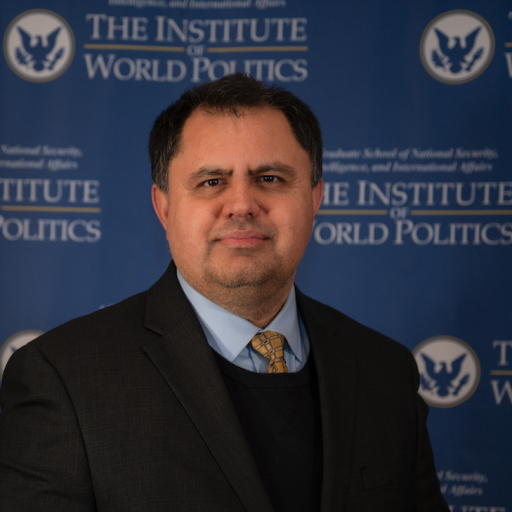
 Ahmad Hashemi, Director of the Middle East and Central Asia Program at the Global Policy Institute (GPI).