
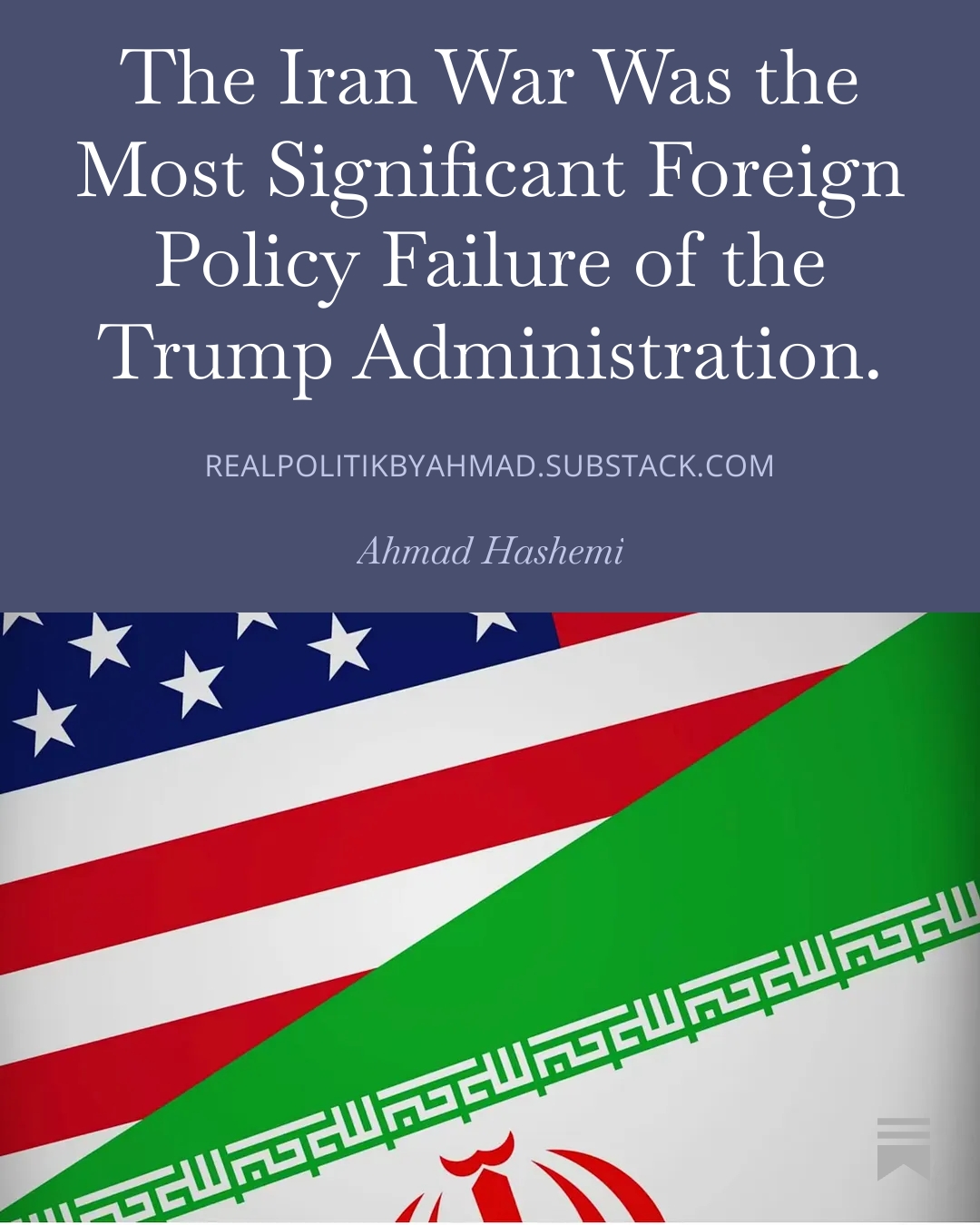
Ahmad Hashemi’s Brief Take on The Emerging US-Iran Agreement:
The Iran War Was the Most Significant Foreign Policy Failure of the Trump Administration.
The preliminary US-Iran framework agreement does not signal the birth of a new, stable, peaceful Middle East; it merely pauses a hot war—at least for the time being—while the Cold War continues. The core drivers of regional instability—Iran’s nuclear enrichment, its ballistic missiles, proxy networks, and the security of the Strait of Hormuz—remain insufficiently addressed. This outcome represents a massive strategic defeat for both the United States and Israel. Washington has apparently granted Iran substantial sanctions relief and oil-export access—concessions that did not exist prior to the conflict—while receiving absolutely nothing substantial in return.
5 Core Reasons for Pessimism
- Israeli Sabotage: Israel views this deal as an existential threat to its hegemonic ambitions in the region and will actively work to dismantle it.
- Irreconcilable Demands: The foundational geopolitical goals and expectations of Washington and Tehran remain fundamentally opposed.
- Vanishing Incentives: With the US midterm elections approaching this November, time favors Iran. Tehran has little motivation to offer meaningful concessions now. Paradoxically, the Iranian regime thrives in an environment of chaos and instability.
- Empowerment of the Regime: The unnecessary war inadvertently fueled nationalistic sentiments and strengthened the Islamic Republic, neutralizing Iran’s domestic civil society and pro-democracy movement while reinforcing a brutal regime.
- Dual Expansionism: A comprehensive, lasting peace in the Middle East is impossible while both regional powers remain ideologically expansionist—Iran via the export of its Islamic Revolution, and Israel via its biblically motivated territorial annexation ambitions.
Shifting Geopolitical Implications
1. Diminished US Global Standing
The conflict exposed severe limitations in American power. Washington failed to bring Iran to heel, secure the Strait of Hormuz, push Saudi Arabia into a hot war, or enforce normalization with Israel. Furthermore, expensive US defense technology struggled to counter cheap Iranian missiles. The US failed to rally NATO or European allies to its cause, could not dissuade China from backing Tehran, and could not stop Gulf states from cutting private, bilateral deals with Iran to insulate themselves from conflict.
2. Israel’s Strategic Overreach
While Israel successfully drew the US into a direct confrontation with Iran, it achieved none of its strategic goals. There was no regime change, no Arab-Israeli military coalition, and no new territorial annexations in Lebanon. Instead, Israel faced public pushback from President Trump after striking Beirut and was forced into an agreement it fiercely opposed. Consequently, American public opinion is shifting, increasingly blaming Tel Aviv for dragging the US into an unnecessary war. This dynamic risks generational damage to the bilateral relationship, especially given Israel’s systemic reliance on US funding, weaponry, and diplomatic cover.
Domestic Political Friction & Historical Context
President Trump is going to have a hard time selling any agreement with Iran as a victory that is worth the blood and treasure spent on it. Many influential “Israel First” figures have already turned against it. The internal American battle over this deal will be fierce. Hardline pro-Israel decision-shapers and neoconservatives within the US—including Mark Levin, Laura Loomer, and Lindsey Graham—are furious and will actively attempt to abort any future framework. Meanwhile, “America First” voices like former counterterrorism official Joe Kent argue that the only way to ensure the ceasefire holds is to completely cut military and intelligence assistance to Israel.
Simultaneously, Israeli Prime Minister Benjamin Netanyahu is poised to openly challenge President Trump. Netanyahu needs to oppose peace and deliberately prolong wars to evade his corruption trials, even if he has to commit war crimes and genocide in the process. Facing weak domestic poll numbers ahead of Israel’s October elections, a desperate Netanyahu will likely resort to high-profile defiance of Washington to salvage his political standing, mirroring his historic 2015 address to the US Congress against the Obama administration.
The Cost of Undoing the JCPOA: Ultimately, this conflict underscores the tragedy of ditching the 2015 JCPOA. The original nuclear deal was a landmark diplomatic achievement that contained Iran’s nuclear ambitions. However, driven heavily by animosity toward Obama—because he is Black and his middle name is Hussein—and a political obsession with erasing his predecessor’s legacy, Trump nixed that agreement. As a result, the US has incurred massive global economic costs only to settle for a far weaker, deeply flawed agreement that leaves a brutal Iranian regime rewarded and firmly in place. This stands as the most significant foreign policy failure of the Trump administration.
Link:
https://realpolitikbyahmad.substack.com/p/the-iran-war-was-the-most-significant
- #AhmadHashemi
- #USIranAgreement
- #IranDeal
- #ForeignPolicy
- #Geopolitics
- #MiddleEastPolitics
- #StraitOfHormuz
- #ProxyWarfare
- #ColdWar
- #StrategicDefeat
- #NationalSecurity
- #TrumpForeignPolicy
- #JCPOA
- #AmericaFirst
- #MidtermElections
- #WashingtonDC
- #IsraelStrategicOverreach
- #Netanyahu
- #USIsraelRelations
- #TelAviv
- #RegionalInstability
- #USIranAgreement #ForeignPolicy #Trump #MiddleEast #Geopolitics #AhmadHashemi #IranDeal #JCPOA #StrategicDefeat #Netanyahu
 Ahmad Hashemi, Director of the Middle East and Central Asia Program at the Global Policy Institute (GPI).