
What Is Iran’s Endgame in the Strait of Hormuz?
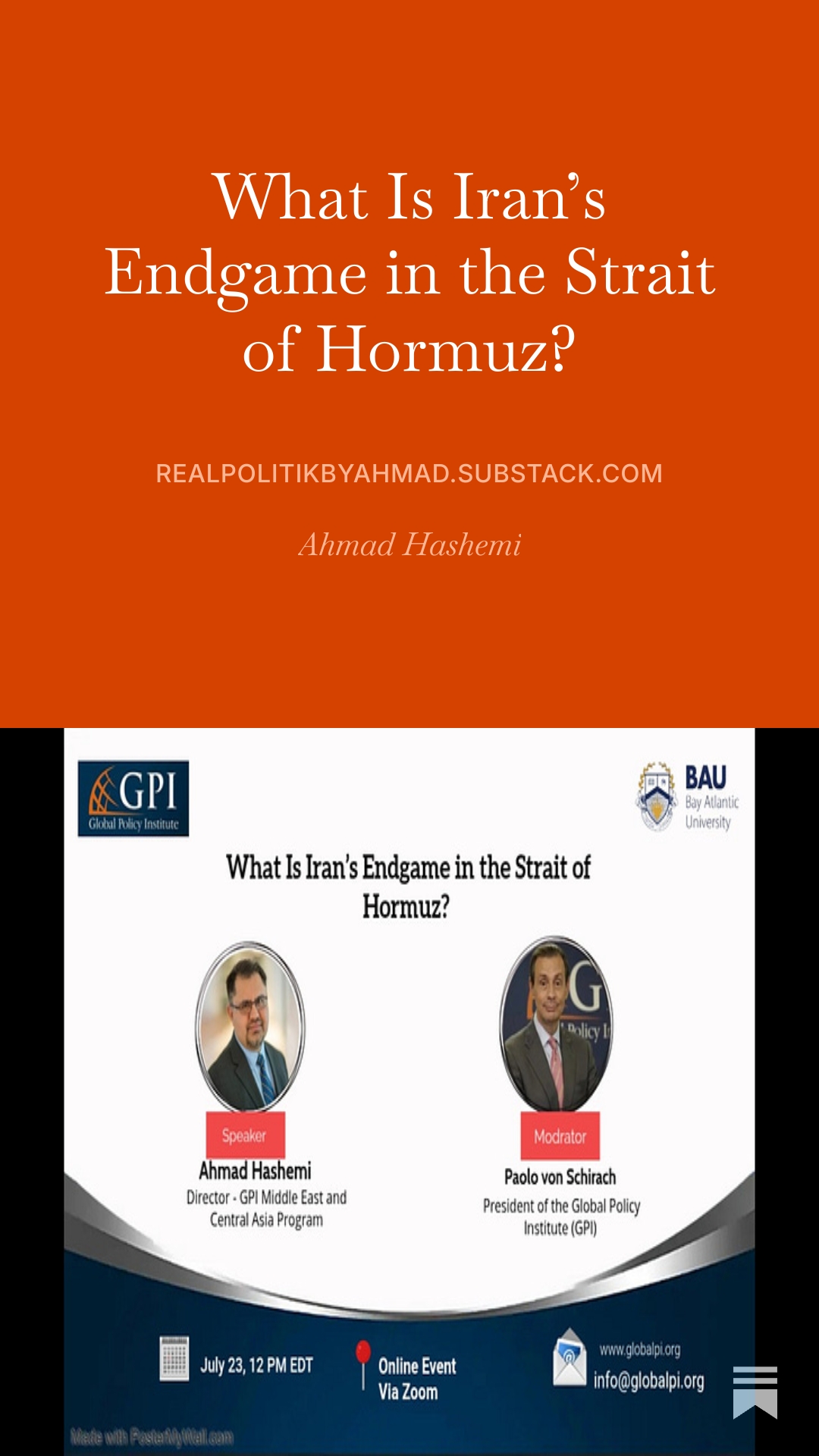
In a recent Global Policy Institute discussion with Professor Paolo Von Schirach, I examined the Iranian regime’s reliance on asymmetric maritime warfare to disrupt the world’s most vital energy chokepoint.
Tehran views controlling or threatening the Strait of Hormuz as an immediate and transactional deterrent against Israel and the United States, as well as a tool to gain leverage in future negotiations. Though Iran’s conventional naval force is almost non-existent, by deploying low-cost drones and missiles produced in decentralized micro-factories, Iran can target commercial shipping to exponentially inflate maritime insurance premiums—effectively strangling global trade without requiring standard naval dominance.
Furthermore, an escalation risks activating regional proxies like Yemen’s Houthis, raising the threat of a coordinated blockade at the Bab-el-Mandeb Strait that would double the strain on global trade and energy markets.
Domestically, the fate of the new supreme leader is unknown; it is unclear whether he is alive or dead, and even if he is alive, whether he is physically and mentally able to run the country. What is crystal clear, though, is that decision-making in Iran has increasingly consolidated under the Islamic Revolutionary Guard Corps (IRGC) commanders. This internal shift makes capitulation, diplomatic concessions, or all-out military confrontation equally unpalatable, as each carries existential risks for the regime.
Consequently, Iran’s most likely strategy is sustaining a low-intensity, prolonged conflict to foster a “rally-around-the-flag” effect and preserve its maritime leverage as an insurance policy for regime survival.
On the U.S. side, domestic pressure from rising energy costs ahead of midterm elections creates an urgent desire for a decisive resolution. If a complete military victory proves elusive, the U.S. administration may opt for high-profile strikes—such as targeting the deeply buried new nuclear site at Pickaxe Mountain—to signal strategic success before negotiating terms for unimpeded navigation in the Strait of Hormuz.
Link:
#AhmadHashemi #StraitOfHormuz #IranGeopolitics #GlobalPolicy #AsymmetricWarfare #Iran #MiddleEastAnalysis #IranEndgame #Geopolitics #MaritimeSecurity #Geopolitics #ForeignPolicy #DefenseAnalysis #IRGC #BabElMande #EnergySecurity #GlobalTrade #OilMarkets #MaritimeSecurity #StraitOfHormuz #Iran #Geopolitics #USForeignPolicy
 Ahmad Hashemi, Director of the Middle East and Central Asia Program at the Global Policy Institute (GPI).